






DIY SEO for Small Business: What Actually Moves the Needle
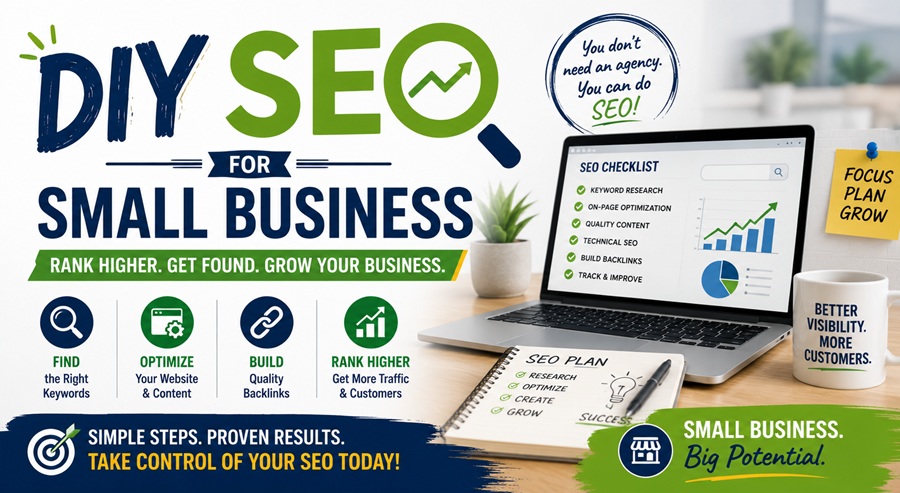
Search engine optimization has a reputation for complexity that benefits agencies and consultants more than it benefits small business owners. The reality is more straightforward: most small businesses don’t need an advanced SEO strategy. They need the fundamentals done well and done consistently.
If you’re willing to invest a few hours a month and learn as you go, you can handle the majority of what your business needs without hiring anyone. Here’s where to focus.
Start With What Google Sees When It Looks at You
Before optimizing anything, you need to understand your current baseline. Two free tools from Google handle this entirely.
Google Search Console shows you which search queries are bringing people to your site, which pages are getting clicks, and whether Google is encountering any technical errors when it tries to crawl your content. If you haven’t connected your site to Search Console yet, do that first — it takes 15 minutes and the data it generates is foundational to everything else.
Google Analytics (or the newer GA4) tells you what happens after people arrive — which pages they visit, how long they stay, and where they exit. Together these two tools give you a working picture of your current SEO performance without spending a dollar.
Claim and Optimize Your Google Business Profile
For most local small businesses, a well-optimized Google Business Profile delivers more visible results than any on-site SEO work. When someone searches for your type of business near their location, the map pack — the three local results that appear above organic search results — is what they see first.
Claiming your profile is free. Optimizing it means filling in every field completely: accurate business name, address, phone number, hours, website, business category, and a thorough description that naturally includes the terms your customers search for. Add photos — real ones of your actual location, staff, and products — because profiles with photos consistently outperform those without in both clicks and calls.
Collect reviews deliberately. Ask satisfied customers directly. Respond to every review, positive and negative. Google’s algorithm treats review volume and recency as ranking signals, and a profile with 40 genuine reviews will outperform a competitor with 8 in almost every local search context.
Understand What Your Customers Are Actually Searching
Keyword research sounds technical but the core of it is simple: figure out what phrases your potential customers type into Google when they’re looking for what you sell.
Start with what you know. Write down every question you’ve ever been asked by a customer, every problem your product or service solves, and every way you’d describe your own business to a stranger. Those are your seed keywords.
Then use free tools to expand and validate them. Google’s own autocomplete suggestions — the dropdown that appears when you start typing in the search bar — show you real searches in real time. The “People Also Ask” box on search results pages is a direct window into related questions worth addressing. Google Keyword Planner (free with a Google Ads account, which you don’t need to run ads to use) shows search volume and competition levels.
For a small business, long-tail keywords — specific, multi-word phrases like “emergency plumber north Austin” or “organic dog grooming Portland” — are typically more valuable than broad single-word terms. They have lower competition and tend to attract people who are further along in the buying process.
Get Your On-Page Basics Right
On-page SEO refers to how individual pages on your website are structured and written. The fundamentals aren’t complicated.
Title tags and meta descriptions. Every page on your site has a title tag — the text that appears as the clickable headline in search results — and a meta description below it. These should include your target keyword naturally, describe the page accurately, and give someone a reason to click. Most website platforms (WordPress, Squarespace, Wix) let you edit these without touching code.
Headers. Use clear, descriptive headings (H1, H2, H3) that include relevant keywords where they fit naturally. Your H1 — the main heading of the page — should match the primary topic of that page.
Content that answers questions. Google’s job is to match searchers with the most useful result for their query. Pages that answer a question thoroughly, clearly, and honestly tend to outperform thin content over time. Write for the person reading, not for an algorithm — the algorithm has gotten remarkably good at telling the difference.
Image alt text. Every image on your site should have a short descriptive alt text that tells Google what the image shows. This is often overlooked and takes minutes to fix.
Build Local Citations Consistently
A local citation is any online mention of your business name, address, and phone number. Google uses citation consistency as a trust signal for local search rankings — if your business information appears differently across different directories, it creates confusion that can suppress your local visibility.
Audit your listings on Yelp, Bing Places, Apple Maps, Facebook, and any industry-specific directories relevant to your business. Make sure your name, address, and phone number (NAP) are identical everywhere — down to abbreviations like “St.” versus “Street.” Inconsistency here is a common problem that’s easy to fix once you know to look for it.
Create Content That Earns Traffic Over Time
One well-written, genuinely useful piece of content on a topic your customers search for regularly can drive consistent organic traffic for years. This is the evergreen content principle applied directly to SEO.
For a small business, this doesn’t mean publishing daily. It means identifying three to five questions your customers regularly ask — the kind that keep coming up in consultations, phone calls, or emails — and writing thorough, honest answers to each one. A plumbing company writing “how to know if you need to replace your water heater” is creating content that a homeowner with a failing water heater will find, read, and potentially act on.
Over time, a library of useful content builds topical authority — Google’s assessment of whether your site is a credible source on a given subject — which benefits your entire site, not just the individual pages.
The One Tool Worth Paying For
Most DIY SEO can be done with free tools, but one paid tool genuinely earns its cost for small businesses doing their own optimization: Google Search Console is free, but a tool like Ahrefs Webmaster Tools (free tier available) or Ubersuggest (low cost) adds keyword tracking, backlink monitoring, and competitor visibility that Google’s native tools don’t provide.
You don’t need an enterprise SEO platform. The entry-level tiers of these tools provide enough data for a small business to make informed decisions without guesswork.
What to Ignore
DIY SEO advice online is full of tactics that either don’t work, no longer work, or actively harm rankings. Keyword stuffing — cramming search terms unnaturally into content — triggers quality penalties. Buying backlinks from link farms produces the same result. Chasing every algorithm update announcement generates busy work without meaningful benefit.
The Google Search Essentials — Google’s own documentation on what it rewards and what it penalizes — is the most reliable source of guidance on what actually matters, written by the people who build the algorithm. It’s worth an hour of your time and cuts through most of the noise in the SEO advice ecosystem.
The Honest Timeline
DIY SEO is not fast. Meaningful organic search results from content and on-page optimization typically take three to six months to materialize, sometimes longer in competitive markets. Local SEO through Google Business Profile tends to produce results faster — often within weeks of optimization.
The businesses that benefit most from DIY SEO are the ones that treat it as an ongoing practice rather than a one-time project. Small, consistent improvements compound over time in ways that sporadic bursts of effort don’t. Half an hour a week, applied consistently to the right things, outperforms a weekend sprint every few months.