





Open a Free Business Checking Account Online With No Deposit: What’s Actually Available and What the Fine Print Says
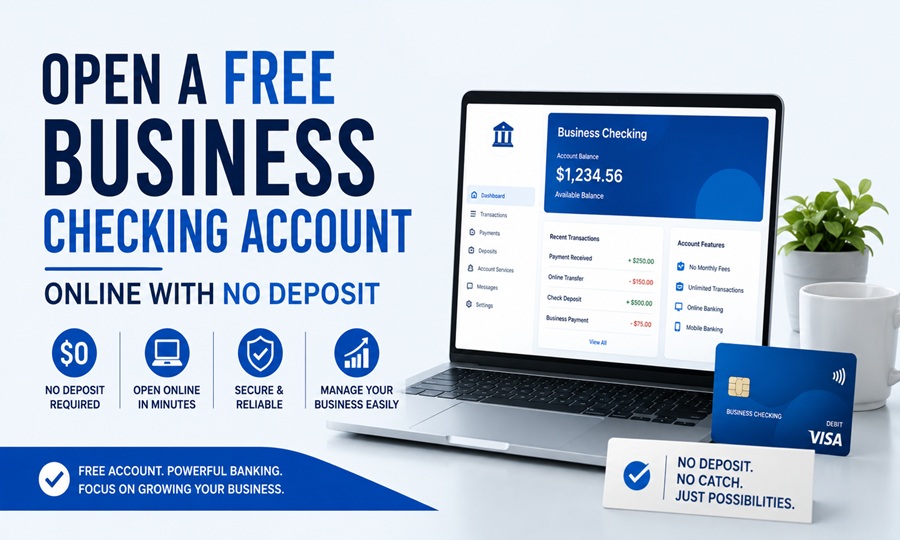
The promise of a free business checking account with no opening deposit sounds straightforward. In practice, the word “free” in banking almost always requires qualification, and understanding what free actually means in the context of business checking accounts prevents the surprise of fees that appear after the account is opened.
The good news is that genuinely useful business checking accounts with no opening deposit requirement and no monthly maintenance fees do exist, and the options have expanded significantly as online banks and fintech companies have entered the business banking market. The caveats are worth understanding before choosing one.
What “Free” and “No Deposit” Actually Mean in Business Banking
A free business checking account typically means no monthly maintenance fee under defined conditions. Those conditions vary by provider. Some accounts are genuinely free with no strings attached. Others waive the monthly fee when a minimum balance is maintained, when a minimum number of transactions occur, or when other products are held with the same institution.
No opening deposit requirement means the account can be opened and activated without an initial funding deposit. It doesn’t mean the account has no minimum balance requirement to maintain fee-free status after opening.
Understanding both conditions before opening an account prevents the situation where an account opened as free generates monthly fees because balance or activity thresholds weren’t met after the initial period.
The Best No-Deposit, No-Fee Business Checking Options Available Now
Several providers offer business checking accounts that genuinely combine no opening deposit requirements with no monthly maintenance fees without conditions that make the “free” label misleading in practice.
Relay Financial
Relay has built one of the strongest reputations in the online business banking market for small businesses and startups. Its business checking accounts have no monthly fees, no minimum balance requirements, no opening deposit requirement, and no transaction fees for standard transactions. It supports up to 20 checking accounts and 50 virtual or physical debit cards per business, making it particularly useful for businesses that want to separate funds by purpose or project without paying for multiple accounts.
Relay integrates directly with QuickBooks Online, Xero, and other accounting platforms, reducing the manual reconciliation work that disconnected banking and accounting systems create. It provides ACH transfers, wire transfers, and check payments within the account interface. FDIC insurance is provided through Thread Bank up to $3 million through a sweep program across multiple banks.
The limitations are those common to online-only banking. Cash deposits aren’t supported. Physical branch access doesn’t exist. For businesses that deal primarily in digital transactions and don’t need cash handling, these limitations rarely affect day-to-day operations.
Bluevine Business Checking
Bluevine offers a business checking account with no monthly fees, no minimum balance requirements, and no opening deposit requirement. Its headline feature is a competitive interest rate on balances, currently among the highest available in the business checking category at rates that have ranged from 1.5 to 2.0 percent APY depending on market conditions, applying to balances up to $250,000.
Bluevine provides unlimited transactions, two free checkbooks per year, and integration with accounting platforms including QuickBooks. Cash deposits are available through Green Dot locations for a fee, which addresses the cash handling limitation common to online business banking. FDIC insurance applies up to $3 million through a program bank network.
Bluevine also offers a business line of credit product, making it a practical option for businesses that want to combine banking and credit access through a single provider relationship.
Mercury
Mercury has positioned itself specifically for startups and technology companies, though its accounts are available to businesses beyond that niche. It offers no monthly fees, no minimum balance requirements, no opening deposit requirement, and a clean, well-designed interface that has made it popular among founders and early-stage businesses.
Mercury provides virtual and physical debit cards, ACH and wire transfers, check payments, and integrations with accounting and payroll software. Its API access for businesses that want to build financial automation is more accessible than at traditional banks. FDIC insurance is provided through Evolve Bank & Trust and Choice Financial Group up to $5 million through a sweep program.
Mercury’s Treasury product, a separate higher-yield account for cash reserves, provides an option for separating operating cash from reserves without requiring a different banking relationship.
Found
Found targets self-employed individuals and freelancers specifically, combining business checking with built-in expense tracking, tax estimation, and invoicing tools. The basic account has no monthly fee and no minimum balance requirement. It automatically estimates quarterly tax obligations based on income and expenses, which addresses one of the most common administrative pain points for self-employed individuals without dedicated accounting software.
Found’s automatic tax set-aside feature reserves a percentage of each payment received into a separate tax account, reducing the year-end surprise of a large tax payment that wasn’t budgeted for. The integrated invoicing and expense categorization make it a functional lightweight accounting system for solo operators who don’t need the full capability of QuickBooks or Xero.
Novo
Novo offers a business checking account with no monthly fees, no minimum balance requirements, and no opening deposit requirement, positioned toward small businesses and freelancers. Its reserve feature allows businesses to set aside funds within the account for specific purposes including taxes, upcoming expenses, and savings goals without requiring separate accounts.
Novo integrates with Shopify, Stripe, Square, and other platforms used by small businesses, with automatic transaction importing that reduces manual bookkeeping. ATM fee reimbursements up to $7 per month partially offset the limitation of having no proprietary ATM network.
Traditional Banks With No-Deposit Business Checking Options
Several traditional banks with physical branch networks offer business checking accounts that can be opened online with no initial deposit requirement, though the fee structures and conditions vary more than with online-only providers.
Chase Business Complete Banking has no opening deposit requirement and a $15 monthly fee that is waived when $2,000 in daily balance is maintained, a Chase Ink Business Card is held, or certain deposit activity thresholds are met. The waiver conditions are achievable for most active businesses, and the Chase branch network and ATM availability provide physical banking access that online-only providers don’t match. Chase’s integration with their broader business banking products including merchant services, payroll, and lending makes it a practical choice for businesses that anticipate needing those services.
Bank of America Business Advantage Fundamentals Banking has no minimum opening deposit and a $16 monthly fee waived with a $5,000 average monthly balance or a $250 monthly spend on a Bank of America business credit card. The balance threshold is higher than many businesses maintain in a checking account, making the fee waiver less reliably achievable than at institutions with lower or no threshold requirements. The branch network and ATM availability are its primary advantages over online alternatives.
Wells Fargo Initiate Business Checking has a $25 monthly fee waived with a $500 average monthly balance, a lower threshold than Bank of America but still a condition that must be actively managed. Its branch network is extensive and its business banking product range is comprehensive, making it a practical choice for businesses that prioritize physical banking access and anticipate growing into more complex banking needs.
What to Look For Beyond the Monthly Fee
Monthly fee is the most visible cost in business checking but not the only one. Several other fee categories affect the total cost of a business checking account and deserve examination before opening one.
Transaction fees apply at some banks when monthly transaction volume exceeds a defined threshold. Traditional banks often charge per-transaction fees above a monthly allotment. Most online business banks offer unlimited transactions with no per-item fees, which benefits businesses with high transaction volumes.
Wire transfer fees vary significantly between providers. Outgoing domestic wires typically run $15 to $30 at traditional banks. Many online providers offer free or lower-cost wires that represent meaningful savings for businesses that send wires regularly.
Cash deposit fees apply at most online banks because they lack the physical infrastructure to accept cash. Fees for cash deposits through partner networks including Green Dot typically run $4.95 to $5.95 per deposit. For businesses that handle significant cash, this fee and the inconvenience of third-party deposit locations is a meaningful limitation that should factor into the account selection.
ATM fees for withdrawals outside the provider’s network run $2.50 to $3.50 at most institutions plus the ATM operator’s fee. Providers that reimburse ATM fees, including Novo up to $7 per month, reduce this cost for businesses with regular cash withdrawal needs.
Insufficient funds and overdraft fees remain significant revenue sources for traditional banks. Online business banking providers including Relay, Mercury, and Bluevine typically decline transactions when funds are insufficient rather than charging overdraft fees, which prevents the cascade of fees that overdraft programs generate at traditional banks.
The Application Process for Online Business Checking
Opening a business checking account online requires documentation that verifies both the business’s legal existence and the identity of its owners. The specific requirements vary by provider but generally include the same core set of documents.
For sole proprietors, the requirements typically include a government-issued photo ID, a Social Security number or EIN, and documentation of the business name if operating under a name other than the owner’s legal name, such as a DBA registration.
For LLCs and corporations, the requirements typically include a government-issued photo ID for all owners with a significant ownership percentage, usually 25 percent or more, the business EIN, the articles of organization or incorporation, and in some cases the operating agreement or bylaws.
Online applications at fintech providers including Relay, Mercury, Bluevine, and Novo typically process within one to three business days with automated verification of submitted documents. Traditional bank online applications sometimes take longer and may require in-person verification for certain business types or ownership structures.
Beneficial ownership requirements under the Financial Crimes Enforcement Network rules require banks to collect and verify information about individuals who own 25 percent or more of a business entity. This requirement applies to all business account openings regardless of the bank and is the reason that multi-owner businesses need documentation from all significant owners rather than just the primary account holder.
Choosing Between Online-Only and Traditional Bank Business Checking
The choice between an online-only business bank and a traditional bank with branch access comes down to the specific needs of the business rather than a universal preference for one model over the other.
Online-only business banks provide lower costs, higher interest rates on balances, cleaner interfaces, and faster account opening. Their limitations are the absence of cash handling capability, no physical branch access, and sometimes limited product breadth beyond the checking account itself.
Traditional banks provide physical branch access, cash handling infrastructure, broader product ranges including lending and merchant services, and established reputations that may matter for business relationships where banking credentials signal stability. Their costs are typically higher and their interest rates on checking balances lower than online alternatives.
Businesses that deal primarily in digital transactions, don’t need cash handling, and want to minimize banking costs are well-served by online-only providers. Businesses with cash-heavy operations, complex banking needs, or strong preferences for in-person service are better served by traditional banks even at higher costs.
Some businesses maintain accounts at both types of institutions: an online account for its interest rate and fee structure for the majority of operating funds, and a traditional bank account for cash deposits and physical banking needs. The two-account approach captures the advantages of each model without the limitations of either constraining the business.
FDIC Insurance and Fund Safety
Any business checking account worth considering carries FDIC insurance that protects deposited funds up to defined limits. Standard FDIC insurance covers $250,000 per depositor per institution.
Several online banks have implemented sweep programs that distribute deposits across multiple FDIC-insured partner banks, providing effective coverage well above the standard $250,000 limit. Relay provides up to $3 million in effective FDIC coverage. Mercury provides up to $5 million. Bluevine provides up to $3 million. For businesses maintaining balances above $250,000, these sweep programs provide protection that a single-bank account without a sweep arrangement doesn’t offer.
The Federal Deposit Insurance Corporation’s BankFind tool allows businesses to verify that any bank they’re considering is FDIC insured and in good standing, and provides information on insurance coverage limits and how insurance applies to different account types and ownership categories.
The Practical Recommendation
For most small businesses and startups looking for a free business checking account with no opening deposit requirement, the online-only providers offer the strongest combination of features, pricing, and usability. Relay is the strongest overall option for businesses that want multiple accounts, accounting software integration, and high FDIC coverage limits. Bluevine is the strongest option for businesses that want to earn meaningful interest on operating balances. Mercury is the strongest option for startups and technology companies that prioritize a clean interface and API access. Found is the strongest option for self-employed individuals who want integrated tax estimation and expense tracking alongside banking.
Traditional banks become the stronger choice when physical branch access, cash handling, or access to lending products through the same institution are genuine requirements rather than occasional conveniences.
Opening one of these accounts takes twenty to thirty minutes, requires no initial deposit, and costs nothing in monthly fees for businesses that meet straightforward operational criteria. The barrier to getting business finances properly separated from personal finances has never been lower, and the cost of not doing so, in accounting complexity and lost tax deductions, continues to be the same.