





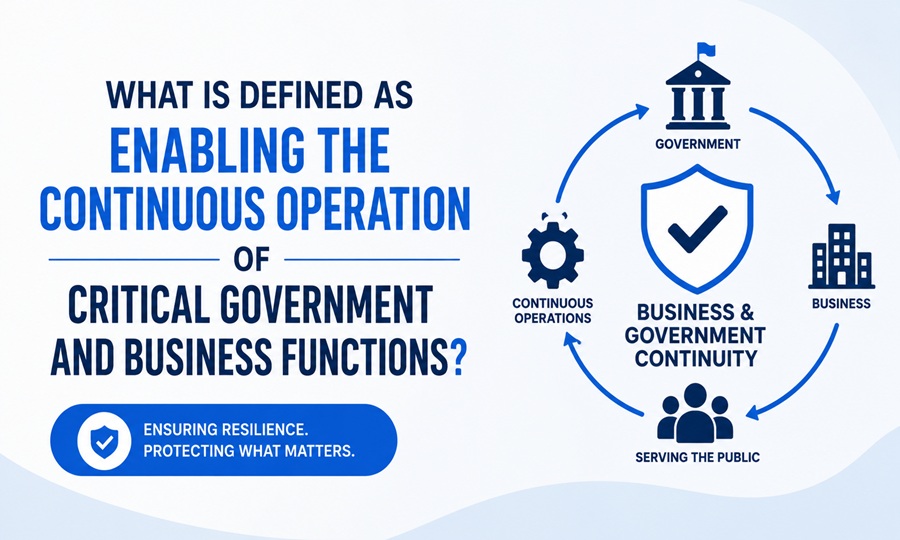
What Is Defined as Enabling the Continuous Operation of Critical Government and Business Functions?
The phrase appears in federal policy, academic literature, and organizational planning frameworks, and it has a specific answer rooted in official US government doctrine. Enabling the continuous operation of critical government and business functions is the definition of continuity planning — specifically, the combined disciplines of Continuity of Operations (COOP) and Continuity of Government (COG) planning at the federal level, and business continuity planning in the private sector.
Understanding what this definition covers, where it comes from, and how it applies in practice matters for anyone working in emergency management, organizational resilience, federal contracting, or critical infrastructure protection.
The Official Source of the Definition
The clearest official articulation of this concept comes from the US Department of Homeland Security and the Federal Emergency Management Agency’s continuity planning frameworks, particularly the National Continuity Policy Implementation Plan and Federal Continuity Directives 1 and 2.
Presidential Policy Directive 40, signed in 2016 and building on decades of prior executive orders and national security directives, established the current framework for national continuity policy. It defines continuity as the ability of the United States government to continue its essential functions across a wide range of threats and emergencies.
Within that framework, enabling the continuous operation of critical government and business functions is operationalized through three interconnected planning disciplines. Continuity of Operations planning ensures that individual agencies and organizations can continue their essential functions during and after disruptions. Continuity of Government planning ensures the survival of constitutional governance and the three branches of government under catastrophic circumstances. Essential Services Continuity planning addresses the private sector critical infrastructure that government essential functions depend on.
What “Critical Functions” Means in This Context
Not every government or business function is considered critical for continuity purposes. The identification of which functions are critical is itself a defined process rather than a subjective judgment.
For federal agencies, Mission Essential Functions are the functions that must be continued or resumed within defined timeframes following an emergency. Each federal department and agency is required to identify its MEFs through a structured analysis that considers the function’s importance to national security, the impact of its interruption on other government functions and the public, and the legal or constitutional basis for the function.
Primary Mission Essential Functions are a subset of MEFs that support the National Essential Functions, the eight fundamental functions of the United States government that must be maintained in all circumstances. These include preserving the constitutional framework of government, providing national leadership and direction, defending the nation against military attack, maintaining foreign relations, protecting constitutional rights, providing essential public health and safety services, maintaining economic order, and providing for federal continuity of government.
For private sector organizations, critical functions are typically defined through a Business Impact Analysis that identifies which functions are essential to the organization’s survival and which support systems, personnel, and resources those functions depend on. The BIA produces the Recovery Time Objectives and Recovery Point Objectives that drive continuity planning priorities.
The National Infrastructure Protection Plan Framework
The private sector dimension of enabling continuous operation of critical functions is addressed through the National Infrastructure Protection Plan, which identifies sixteen critical infrastructure sectors whose assets, systems, and networks are considered so vital that their incapacitation or destruction would have a debilitating effect on national security, economic security, public health and safety, or any combination thereof.
These sixteen sectors are chemical, commercial facilities, communications, critical manufacturing, dams, defense industrial base, emergency services, energy, financial services, food and agriculture, government facilities, healthcare and public health, information technology, nuclear reactors and materials, transportation systems, and water and wastewater systems.
For businesses operating within these sectors, enabling continuous operation isn’t just an organizational preference. It’s a national security imperative that has generated specific regulatory requirements, federal guidance documents, and in some sectors legally mandated planning and reporting obligations.
The energy sector, for example, operates under NERC Critical Infrastructure Protection standards that mandate specific reliability and continuity requirements for entities operating the bulk electric system. Financial institutions subject to FFIEC guidance must maintain comprehensive business continuity programs addressing technology systems, vendor dependencies, and recovery capabilities. Healthcare organizations subject to HIPAA must address contingency planning including data backup, disaster recovery, and emergency operations procedures as a component of security rule compliance.
How Continuity Planning Enables Continuous Operation
The practical mechanisms through which continuity planning enables continuous operations fall into several categories that apply across government and business contexts.
Succession of authority and orders of succession ensure that the authority to make critical decisions transfers automatically to designated alternates when primary decision-makers are unavailable. Without clear, pre-established succession, decision-making authority gaps during emergencies create operational paralysis that defeats continuity objectives even when physical and technological resources are intact.
Alternate facilities and operating locations provide the physical infrastructure to continue operations when primary facilities are inaccessible or destroyed. Federal agencies maintain alternate operating facilities that are pre-positioned with the equipment, connectivity, and resources needed to support essential functions without setup time during an actual emergency. Private sector continuity programs similarly identify alternate work sites, remote work capabilities, and reciprocal arrangements with partner organizations.
Vital records and systems protection preserves the information and access to information systems that essential functions depend on. Continuity planning requires identification of vital records, their protection through backup, redundancy, and secure offsite storage, and the procedures for accessing them when normal access is unavailable.
Devolution of operational control plans for the transfer of authority and responsibilities to an alternate organization or location when the primary organization is unable to perform its essential functions. Devolution is distinct from delegation in that it represents a more comprehensive transfer of capability rather than temporary assignment of specific tasks.
Reconstitution procedures define how the organization returns to normal operations after the emergency has passed, restoring full capability and transitioning from contingency operations back to standard operations in a controlled, documented manner.
The NIST Framework Connection
In the cybersecurity context, enabling continuous operation of critical functions is addressed through the National Institute of Standards and Technology’s Cybersecurity Framework, which includes Recover as one of its five core functions alongside Identify, Protect, Detect, and Respond.
The Recover function specifically addresses the development and implementation of resilience activities and the restoration of capabilities impaired by a cybersecurity event. Within federal systems, NIST Special Publication 800-34, the Contingency Planning Guide for Federal Information Systems, provides detailed guidance on information system contingency planning that enables continuous operation of the information technology functions that both government and business essential functions depend on.
For businesses seeking to understand how cybersecurity continuity planning aligns with the broader continuity framework, the NIST guidance provides the most technically detailed and authoritative treatment of the subject available.
Applicability to Federal Contractors
The question of what enables continuous operation of critical government and business functions has direct contractual relevance for businesses operating as federal contractors or subcontractors supporting federal agency missions.
Federal Acquisition Regulation requirements and agency-specific contract clauses increasingly require contractors supporting federal essential functions to maintain their own continuity programs that address their ability to continue contract performance during emergencies. A contractor providing IT support to a federal agency with Mission Essential Functions has an obligation to ensure its own operations can continue during the disruptions that would activate the agency’s continuity plan.
The Defense Contract Management Agency and other federal oversight bodies evaluate contractor continuity programs as part of their risk management and contractor oversight activities, and the absence of adequate continuity planning can affect contract performance ratings and future award decisions.
State and Local Government Continuity
Below the federal level, state and local governments maintain their own continuity programs that address the continuation of essential state and local functions including emergency services, public safety, public health, courts, and the administration of benefits and services that citizens depend on.
FEMA’s Continuity Excellence Series provides training and certification programs for state, local, tribal, and territorial government continuity planners, establishing professional standards for the discipline at all levels of government. The Continuity Assistance Tool provides templates and guidance for smaller jurisdictions that lack the dedicated planning resources of larger governments.
The interdependency between federal, state, local, and private sector continuity programs means that continuity planning at any level requires understanding the dependencies and handoffs across all levels rather than treating each organization’s program in isolation.
The Authoritative Reference
The most comprehensive and authoritative single source for the official definition and framework governing the continuous operation of critical government and business functions is FEMA’s Continuity Resource Toolkit, which consolidates federal continuity directives, planning templates, training resources, and policy guidance into a single resource center for practitioners at all levels of government and in the private sector.
Practical Implications for Organizations
For organizations asking this question in a practical rather than academic context, the definition points toward several concrete obligations and opportunities.
Organizations in critical infrastructure sectors should understand which federal continuity requirements and guidance documents apply to their sector and whether their current continuity programs address those requirements adequately.
Organizations seeking federal contracts in sectors supporting government essential functions should develop continuity programs that reflect federal standards and can withstand scrutiny during contractor evaluation processes.
Organizations building or updating business continuity programs benefit from aligning their frameworks with federal standards not because the federal requirements apply to them directly but because those standards represent the most thoroughly developed and tested continuity planning methodology available.
Emergency managers and continuity planners at any level of government or in the private sector who want professional credentials in this discipline should be aware that FEMA’s continuity training curriculum and the credentials it produces are the recognized professional standard for the field.